Most people don’t think about breathing when they’re trying to last longer.
They focus on technique, speed, pelvic floor exercises, or trying to distract themselves.
But breathing changes as arousal rises.
You may start taking shorter breaths, tightening your stomach, lifting your shoulders, and holding more tension through your pelvic floor.
Belly breathing gives you a simple way to work on the opposite pattern.
Instead of breathing quickly into your chest, you slow things down and let your abdomen expand with each inhale.
It sounds basic, but it’s worth learning properly.
What Is Belly Breathing?
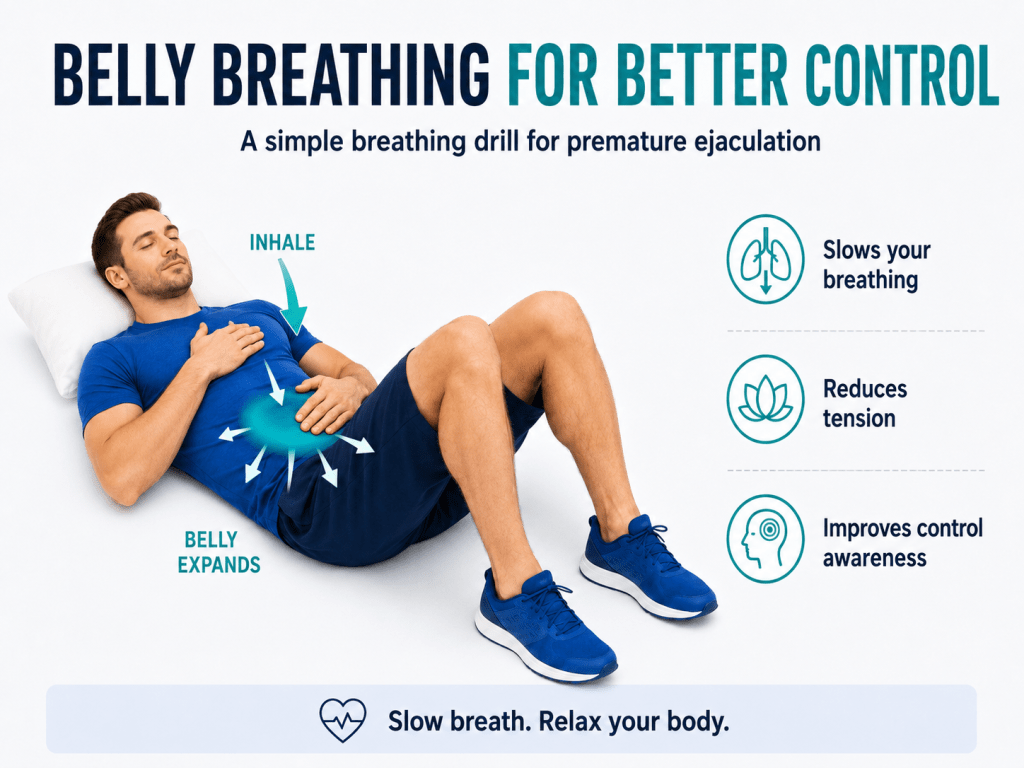
Belly breathing is also called diaphragmatic breathing.
When you inhale, your diaphragm moves downward and your abdomen naturally expands.
You’re not literally filling your stomach with air.
You’re simply allowing your belly to move instead of taking shallow breaths high in your chest.
A relaxed breath should look something like this:
- your belly gently expands as you inhale
- your chest stays relatively quiet
- your shoulders don’t rise
- your jaw and stomach stay relaxed
- the exhale is slow and easy
You shouldn’t be forcing a huge breath.
The movement can be quite small.
Why Use Belly Breathing for Premature Ejaculation?
As arousal increases, tension often increases with it.
You might notice:
- faster breathing
- a tight stomach
- clenched glutes
- tension around the pelvic floor
- a feeling that everything is speeding up
The problem is that many men only notice these changes when they’re already very close to ejaculation.
Belly breathing gives you something simple to pay attention to earlier.
It can also work well alongside pelvic floor relaxation.
If you can keep your breathing slower while staying aware of tension in the pelvic floor, it becomes easier to recognize when your body is starting to tighten up.
That doesn’t mean one deep breath will suddenly stop ejaculation.
The useful part is practicing enough that slow breathing becomes something you can return to when arousal starts climbing.
How to Practice Belly Breathing
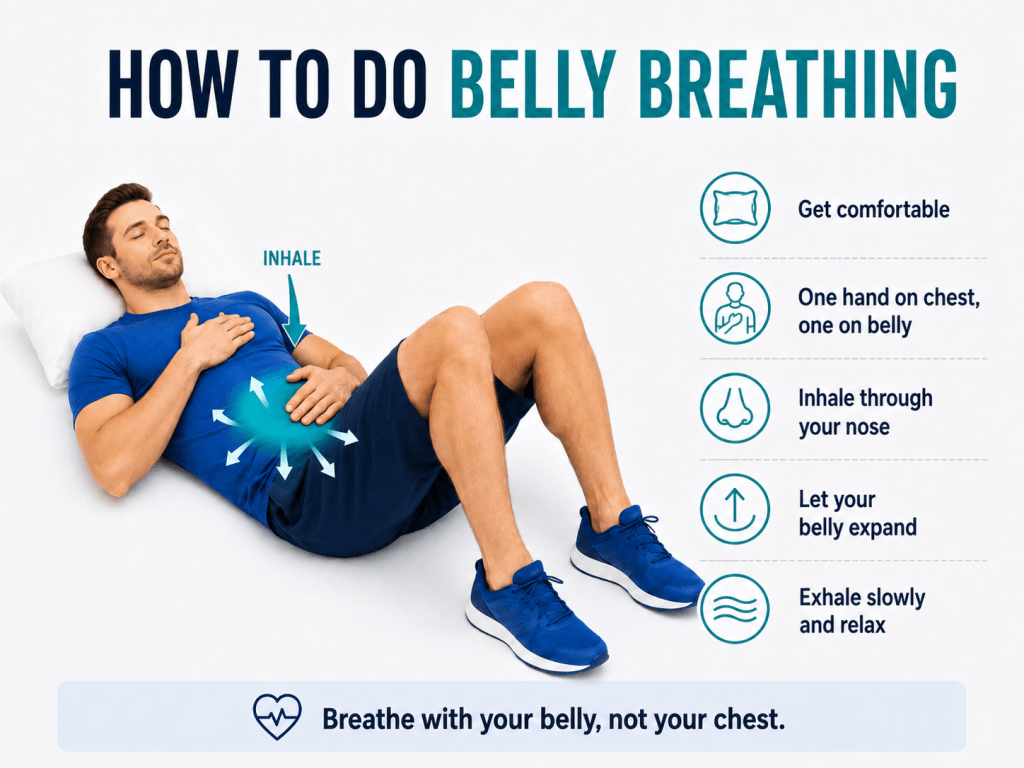
Start somewhere comfortable.
Lying on your back is often easiest because you can clearly feel whether your stomach is moving.
Put one hand on your chest and the other on your belly.
Take a slow breath in through your nose.
Try to let the hand on your stomach rise while the hand on your chest stays relatively still.
There’s no need to suck in as much air as possible.
Just take a comfortable breath.
Then slowly breathe out and let your belly fall again.
A simple rhythm to begin with is:
- inhale for around 4 seconds
- exhale for around 5–6 seconds
- repeat for 8–10 breaths
If counting makes you tense, forget the numbers.
The important part is that the breath stays slow and comfortable.
What Should It Feel Like?
Your stomach should feel soft rather than braced.
Your shoulders should stay down.
You shouldn’t feel like you’re doing a breathing workout.
If you’re taking enormous breaths and getting lightheaded, you’re probably trying too hard.
Slow it down.
A good belly breath should feel almost boring.
That’s fine.
You’re practicing relaxation and awareness, not trying to set a record for how much air you can inhale.
Combine It With a Reverse Kegel
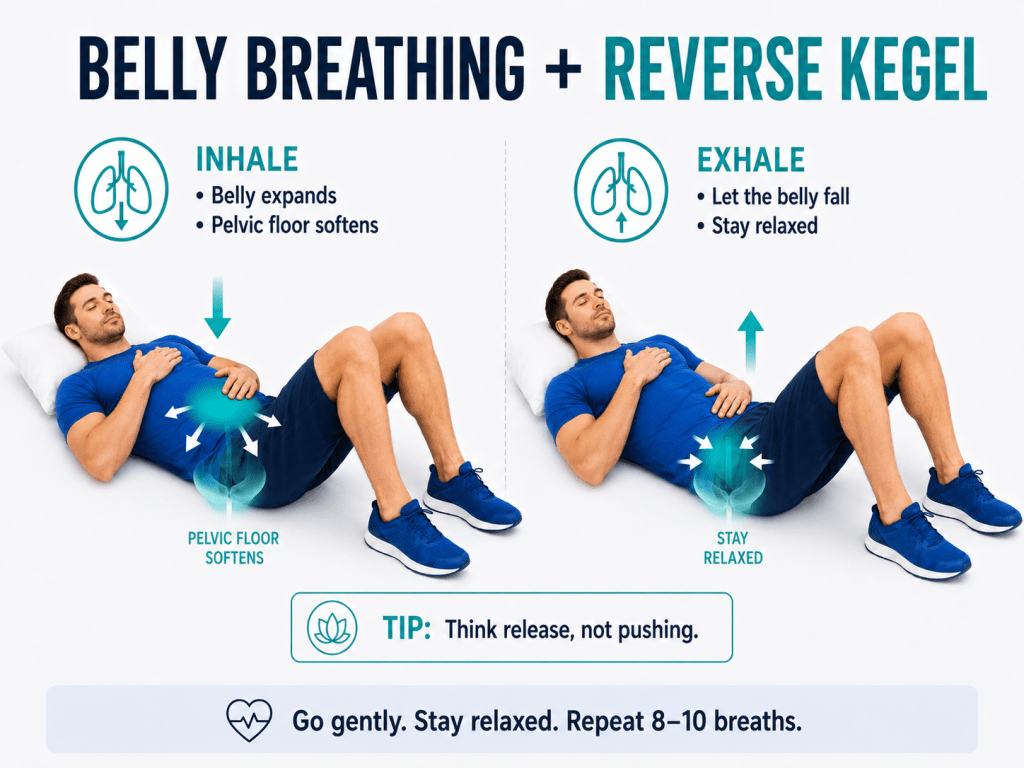
Once belly breathing feels natural, you can combine it with a gentle Reverse Kegel.
As you inhale and your belly expands, let your pelvic floor relax as well.
Think about the area softening rather than squeezing.
You may feel a slight downward release.
Don’t push hard.
A Reverse Kegel shouldn’t feel like straining on the toilet.
Then breathe out slowly and stay relaxed.
You can practice:
- slow inhale
- belly expands
- pelvic floor relaxes
- slow exhale
- repeat 8–10 times
This combination is useful because it teaches you to connect slower breathing with less pelvic floor tension.
Common Belly Breathing Mistakes
Taking breaths that are too big
Belly breathing doesn’t mean inhaling as much air as physically possible.
Keep it comfortable.
Lifting your shoulders
If your shoulders rise every time you inhale, you’re probably breathing more into your upper chest.
Try using less effort.
Tightening your abs
Your stomach needs room to expand.
If you’re bracing your abs the whole time, the movement becomes harder.
Forcing the Reverse Kegel
The pelvic floor should relax with the breath.
You don’t need to aggressively push downward.
Only practicing when you’re already highly aroused
It’s much easier to learn the breathing pattern when you’re calm.
Practice it separately first.
Then start using the same technique during arousal training.
How Long Should You Practice?
You don’t need a long session.
Start with around 2–5 minutes per day.
For example:
- 8–10 slow belly breaths
- short rest
- another 8–10 breaths if you want
Once it becomes easy, you can practice the same breathing while working on arousal control.
That’s when it becomes more practical.
You may notice your breathing speeding up as arousal increases.
Instead of waiting until you’re almost at the point of no return, slow your breathing earlier.
The goal is to recognize the change before control becomes difficult.
Belly Breathing Isn’t About Staying Completely Relaxed
You’re not trying to keep your entire body completely loose during sex.
Some muscle tension is normal.
The useful skill is being able to notice when tension is rising unnecessarily.
If your breathing suddenly becomes fast and shallow and your pelvic floor starts tightening, that can be a useful sign that your arousal is climbing quickly.
Slow breathing gives you one way to respond before things get too intense.
Where to Go From Here
Belly breathing works best when it’s part of a broader routine.
You can combine it with:
- Reverse Kegels
- pelvic floor awareness
- Stop-Start training
- arousal control
The individual techniques are simple.
The harder part is knowing how to practice them together and when to use each one.
That’s what Last Longer Academy is designed around.
Inside the Academy, belly breathing is combined with pelvic floor work, Reverse Kegels, Stop-Start training, and arousal control in a structured routine.
If you want a clearer way to practice these skills instead of jumping between random exercises, you can check out Last Longer Academy here.


Leave a Reply