If you’ve just started doing Kegels, one of the first questions is usually:
How many should I actually do?
The answer is not “as many as possible.”
Kegels are still muscle training. Doing hundreds of hard contractions every day does not automatically mean faster progress. Once your technique starts falling apart, adding more repetitions isn’t particularly useful.
For most men, a better approach is to start with a small number of controlled contractions and build from there.
If you’re still learning the movement itself, start with our How to Do Kegels for Men guide first.
A Good Starting Point
If you’re new to Kegels, keep it simple.
Try:
- 8–10 Kegels per session
- hold each contraction for around 3 seconds
- relax for around 3–5 seconds
- start with 1–2 sessions per day
That gives you enough practice to learn the movement without turning it into a marathon.
Once the exercise feels easy and you can isolate the pelvic floor properly, you can gradually increase the amount.
A common target is around 10 controlled contractions per set, performed a few times throughout the day.
How Many Kegels Should Men Do Per Day?

You don’t need to start with a huge number.
A reasonable progression might eventually bring you toward roughly:
20–30 controlled Kegels per day
For example:
- 10 in the morning
- 10 later in the day
- 10 in the evening
But there’s no reason to force yourself to reach that number immediately.
If you’re completely new, 8–10 good repetitions once or twice per day gives you plenty of time to learn the exercise properly.
Quality Matters More Than the Number
This is where a lot of men go wrong.
They focus completely on the number.
50 Kegels.
100 Kegels.
200 Kegels.
But after the first few repetitions, they may start squeezing their glutes, tightening their abs and holding their breath.
At that point, doing more isn’t necessarily helping.
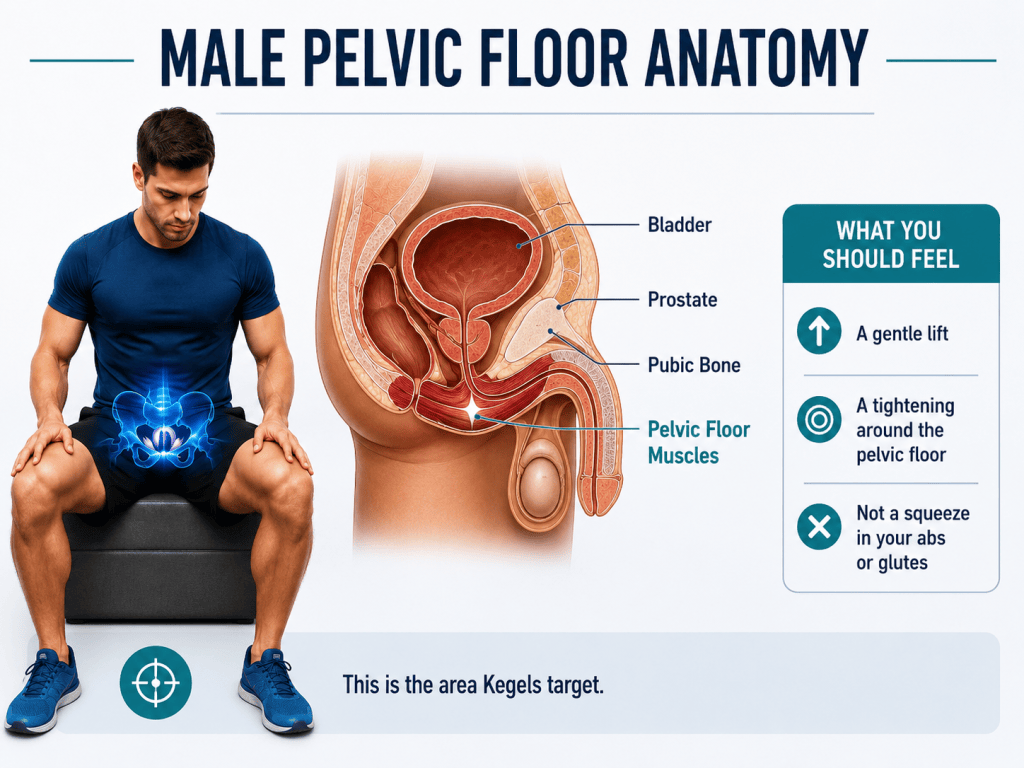
During a proper Kegel:
- your glutes should stay relatively relaxed
- your thighs shouldn’t be squeezing together
- your abs shouldn’t be aggressively braced
- you should continue breathing normally
Ten clean repetitions are better than fifty rushed ones.
If you’re unsure whether you’re actually using the right muscles, read How to Do Kegels for Men for a full explanation of the technique.
How Long Should You Hold Each Kegel?
If you’re a beginner, around 3 seconds is enough.
Contract the pelvic floor gently.
Hold.
Then completely relax before the next repetition.
A simple rhythm is:
3 seconds contracted
3–5 seconds relaxed
As your control improves, you can gradually work toward longer contractions.
For example, you could eventually move from three-second holds to five-second holds.
There’s no need to rush.
And don’t forget the relaxation period. You shouldn’t keep your pelvic floor half-contracted while waiting for the next repetition.
Should You Do Kegels Every Day?
Kegels are commonly practiced every day.
Short sessions are also much easier to stay consistent with than doing one huge workout every few days.
You can attach them to something you already do.
For example:
- after waking up
- after brushing your teeth
- during a short break
- before bed
A session only takes a few minutes.
Consistency matters much more than occasionally doing a massive number of repetitions.
Can You Do Too Many Kegels?
Yes.
The pelvic floor is made of muscles, and muscles can become tired.
Signs that you may be doing too much include:
- the area feels tired after training
- your contractions become noticeably weaker
- you start compensating with your abs or glutes
- your pelvic floor feels unusually tense
- the exercise becomes uncomfortable
If that happens, don’t respond by adding even more repetitions.
Reduce the amount and make sure you’re actually relaxing between contractions.
This is also why it’s useful to understand the difference between strengthening and relaxing the pelvic floor. We explain that in Kegels vs Reverse Kegels for Men.
Do You Need to Do 100 Kegels a Day?
No.
There’s nothing special about reaching 100 repetitions.
High numbers look impressive on a workout plan, but the number itself doesn’t tell you whether you’re training well.
If you do 100 Kegels and spend the last 70 squeezing your glutes, holding your breath and barely relaxing between repetitions, you’re probably not getting much value from those extra reps.
Keep the contractions controlled.
What If Your Goal Is Lasting Longer?
This is where things become a little different.
If you’re using Kegels because you want better ejaculatory control, I wouldn’t make your entire routine about doing more and more contractions.
The pelvic floor also needs to relax.
As arousal increases, some men notice that their pelvic floor becomes increasingly tense without them deliberately contracting it.
So alongside learning how to squeeze the pelvic floor, it can be useful to learn what relaxation feels like too.
That’s the main difference between regular and Reverse Kegels. If you’re not sure which one you should be using, read Kegels vs Reverse Kegels for Men.
Slow belly breathing can also be useful when you’re practicing pelvic floor relaxation.
We have a separate guide showing exactly How to Do Belly Breathing for Premature Ejaculation.
A Simple Routine
If you’re just getting started, there’s no need to overcomplicate it.
Try:
Kegels
- 8–10 repetitions
- contract for around 3 seconds
- relax for 3–5 seconds
- keep breathing normally
Afterward, spend a minute or two simply relaxing.
You can also add slow belly breathing if you want to practice reducing pelvic floor tension after your contractions.
When Should You Increase the Difficulty?
Don’t increase your routine just because a week has passed.
Increase it when the current version feels easy and controlled.
For example, you might change:
8 repetitions → 10 repetitions
or:
3-second holds → 5-second holds
You don’t need to increase both at the same time.
Your technique should still look and feel clean at the end of the session.
How Long Until You Notice a Difference?
Don’t judge pelvic floor training after three days.
Like any type of muscle and coordination training, it takes time to become more familiar with the movement.
What matters more is whether you’re gradually getting better at:
- finding the pelvic floor
- contracting it without using your entire body
- controlling the strength of the contraction
- completely relaxing afterward
Give yourself time before constantly changing the routine.
The Simple Answer
If you only want the basic recommendation:
Beginner
- 8–10 Kegels
- 1–2 sessions per day
- 3-second contraction
- 3–5 seconds relaxed
As you improve
- work toward around 10 controlled repetitions per session
- gradually add another session if needed
- increase hold times slowly
- continue relaxing fully between repetitions
Most importantly:
Don’t chase huge numbers.
Learn to control the correct muscles first.
Want a More Structured Training Routine?
Knowing how many Kegels to do is useful.
But if your main goal is lasting longer, there are other skills involved too.
You need to learn when to contract the pelvic floor, when to relax it, how to control your breathing and how to recognize when your arousal is climbing too quickly.
That’s what we work on inside Last Longer Academy.
The training combines Kegels, Reverse Kegels, belly breathing, Stop-Start practice and arousal control into structured routines, so you have a clear idea of what to practice and how the different techniques fit together.
If you’re looking for a structured way to train these skills rather than figuring everything out on your own, you can check out Last Longer Academy here.
 LastLonger.blog
Leave a comment