Kegels look simple.
You squeeze your pelvic floor, hold for a few seconds, relax, and repeat.
But a lot of men make them harder than they need to be. They squeeze at full strength, tense their abs and glutes at the same time, hold their breath, and then try to do 100 repetitions a day.
That isn’t the goal.
A good Kegel is a small, controlled contraction of the pelvic floor. You should be able to tighten the muscles, hold the contraction, and then let them fully relax again.
Here’s how to do it properly.
What Is a Kegel?
A Kegel is a contraction of your pelvic floor muscles.
The pelvic floor sits at the bottom of your pelvis and plays a role in bladder control, bowel function and sexual function.
For men, learning how to control these muscles can improve pelvic floor awareness and coordination.
The important word here is control.
You’re not simply trying to make the muscles as strong as possible. You want to know when they’re contracting, how hard you’re contracting them, and whether you can relax them afterward.
How to Find Your Pelvic Floor Muscles
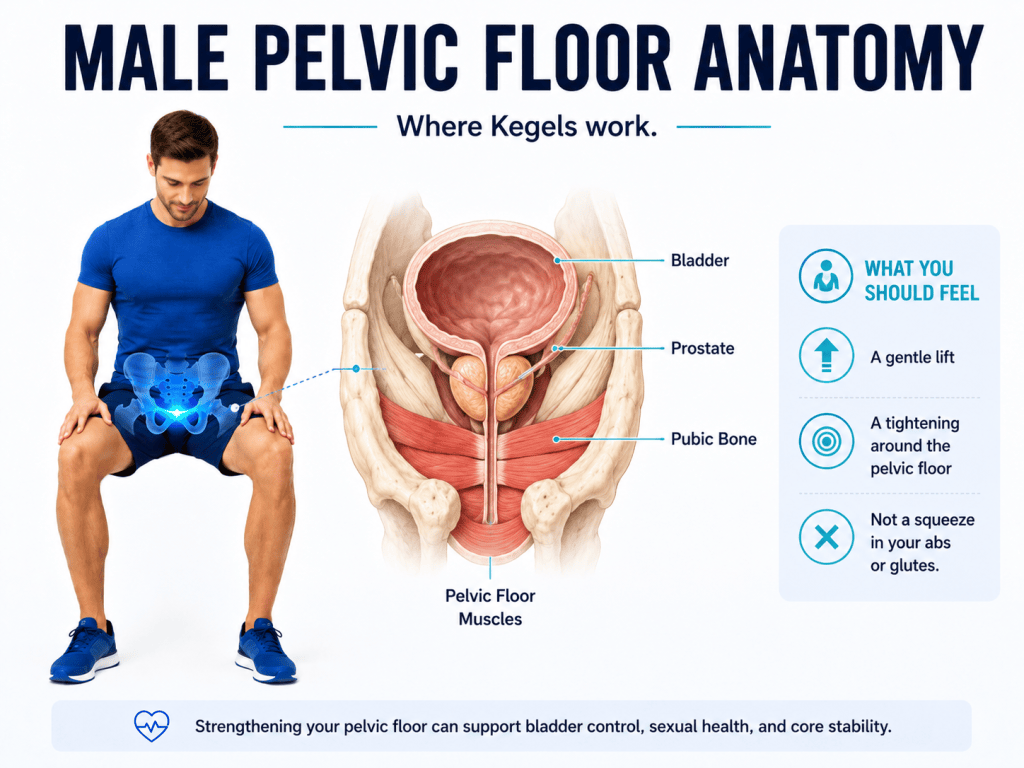
The easiest way to recognize the muscles is to imagine that you’re trying to briefly stop urine flow.
You should feel a tightening around the pelvic floor, almost like the area is lifting slightly upward.
You can also imagine trying to prevent yourself from passing gas. You should feel a similar contraction.
Once you know which muscles you’re looking for, practice the contraction normally.
You don’t need to repeatedly stop your urine while going to the bathroom. Think of that only as a way to recognize the muscles.
How to Do a Proper Kegel
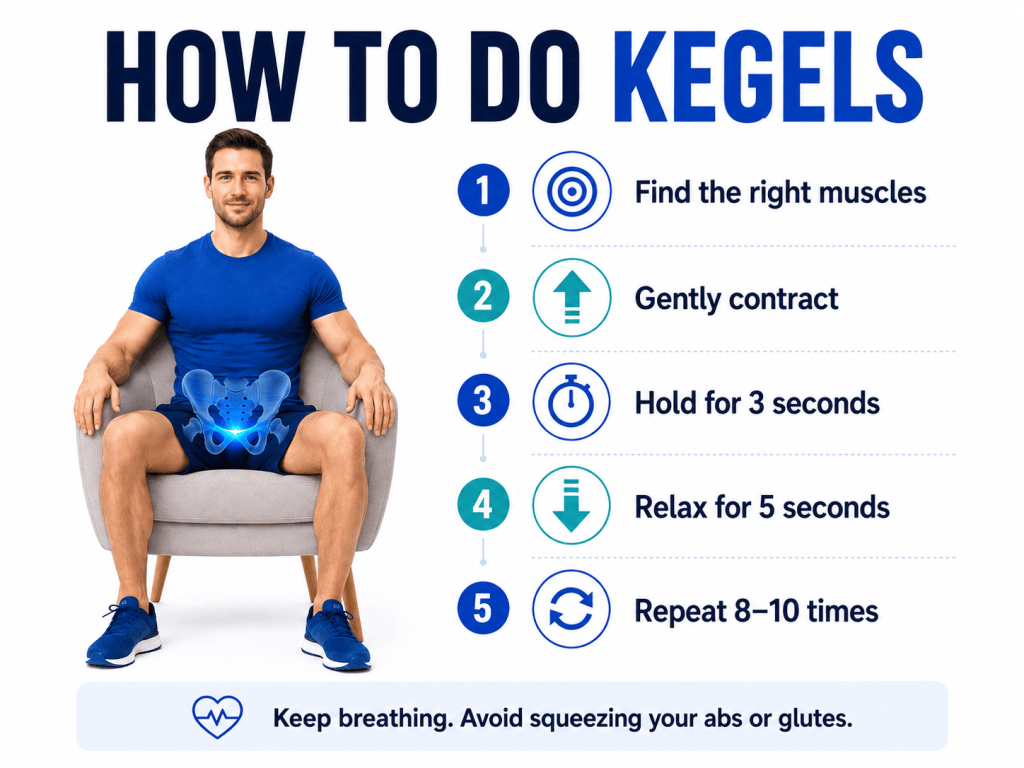
Sit or lie somewhere comfortable when you first start.
Relax your legs, stomach and glutes.
Now gently tighten the pelvic floor.
You should feel the muscles contract and lift slightly.
Hold that contraction for around 3 seconds.
Keep breathing normally.
Then completely relax the pelvic floor for around 5 seconds before doing another repetition.
A simple beginner routine is:
- Contract for 3 seconds
- Relax for 5 seconds
- Repeat 8–10 times
That’s enough to start.
You don’t need to squeeze at maximum strength.
A moderate, controlled contraction is usually much easier to perform correctly.
What Should a Kegel Feel Like?
A proper Kegel is fairly subtle.
You shouldn’t feel like you’re doing a full-body exercise.
Your:
- glutes should stay relaxed
- thighs should stay relaxed
- stomach shouldn’t be aggressively braced
- breathing should continue normally
If your face is turning red and you’re holding your breath, you’re probably trying too hard.
Reduce the intensity and focus on isolating the pelvic floor.
It can help to think about gently lifting the muscles rather than simply squeezing everything as hard as possible.
Don’t Forget the Relaxation
This is one of the easiest parts to ignore.
After every Kegel contraction, let the pelvic floor relax completely.
Don’t immediately jump into the next repetition.
If you contract for three seconds, give yourself around five seconds of relaxation afterward.
Being able to relax the pelvic floor matters just as much as being able to contract it.
If you’re interested in that side of pelvic floor training, this is also where Reverse Kegels come in. Reverse Kegels focus specifically on relaxing and releasing the pelvic floor rather than contracting it.
Common Kegel Mistakes
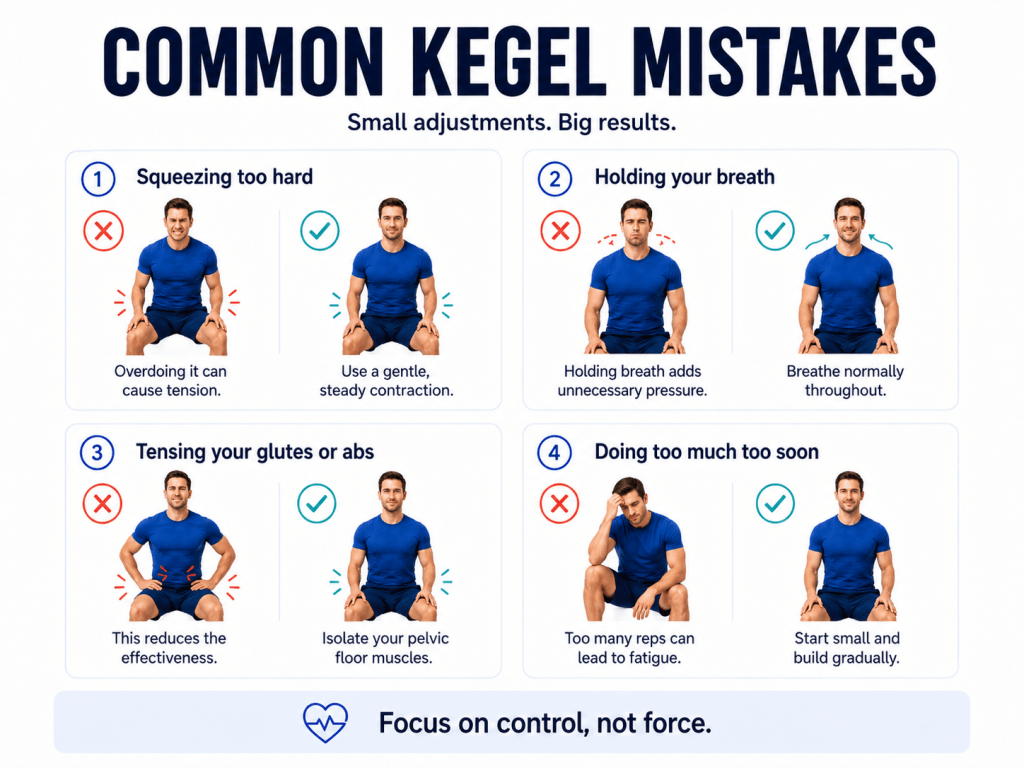
Squeezing as hard as possible
Harder isn’t automatically better.
You’re trying to learn controlled contractions, not test the maximum force your pelvic floor can produce.
Start gently.
Doing hundreds of repetitions
You don’t need a huge number of Kegels.
More repetitions don’t automatically mean faster progress.
A small number of good contractions is better than doing 100 poor ones while tensing your entire body.
Holding your breath
Keep breathing normally during the contraction.
If you automatically hold your breath, try using a slightly weaker contraction.
Squeezing your glutes
This is extremely common.
If your butt is tightening hard every time you perform a Kegel, you’re involving more muscles than necessary.
Relax your glutes and focus on the pelvic floor.
Tightening your stomach
A little natural abdominal activity can happen, but you shouldn’t be bracing your abs hard.
Try to keep your stomach relatively relaxed.
Never relaxing between repetitions
The relaxation phase is part of the exercise.
Let the pelvic floor completely release before the next contraction.
How Often Should You Do Kegels?
If you’re new to pelvic floor training, start conservatively.
One simple session could be:
8–10 contractions
with:
3 seconds contracted / 5 seconds relaxed
You can focus on learning the movement correctly before worrying about adding more repetitions or longer holds.
If the area feels tired, uncomfortable or unusually tense, don’t keep adding more work just because you think more is better.
Pelvic floor muscles still need recovery.
What About Kegels for Lasting Longer?
This is where Kegels get a lot of attention.
Pelvic floor control can be relevant when working on ejaculatory control, but simply doing more Kegels isn’t the entire answer.
As arousal increases, the pelvic floor can become more active and tense.
The useful skill isn’t only being able to squeeze these muscles.
It’s also being able to recognize what they’re doing.
Ask yourself:
- Am I tightening my pelvic floor without noticing?
- Am I holding my breath?
- Are my abs and glutes becoming tense?
- Does the tension increase as I get closer to ejaculation?
That awareness becomes much more useful than simply counting repetitions.
This is also why Kegels and Reverse Kegels are often trained together.
One teaches contraction.
The other teaches relaxation.
Should You Do Kegels and Reverse Kegels Together?
They don’t have to be treated as competing exercises.
A basic routine might include a few controlled Kegel contractions followed by slow breathing and pelvic floor relaxation.
For example:
Kegels
- 3-second contraction
- 5-second relaxation
- 8–10 repetitions
Then spend a few minutes doing slow belly breathing and letting the pelvic floor stay relaxed.
This gives you practice with both sides of pelvic floor control instead of training only contraction.
When Kegels Aren’t Enough
If your main goal is to last longer, learning a proper Kegel is useful.
But it doesn’t automatically teach you:
- how to recognize rising arousal
- when to slow down
- how to use the Stop-Start Method
- how to relax your pelvic floor during stimulation
- how breathing changes as arousal increases
Those skills need to be practiced too.
And this is where a lot of men get confused.
They know five different exercises, but they don’t know what to practice first or how the exercises fit together.
Want a Structured Training Routine?
That’s the reason Last Longer Academy includes more than just Kegels.
The training brings together:
- Kegels
- Reverse Kegels
- belly breathing
- pelvic floor relaxation
- Stop-Start practice
- arousal awareness
- structured training routines
The idea isn’t to give you another random exercise.
It’s to show you how the different techniques fit together and give you a clear routine to follow.
If you want to go beyond basic Kegels and work on pelvic floor control and lasting longer in a more structured way, you can check out Last Longer Academy here.


Leave a Reply